Wheelchair basketball has long been a feature at GDPU. From 25th to 30th September 2017 Gulu PWDs Electronic, one of the three pilot groups on the ETC@GDPU project, along with other members of Gulu Wheelchair Basketball Team took part in a National Sport Gala for Persons with Disabilities.
Spectators at the 2017 National Disability Sports Gala in Gulu
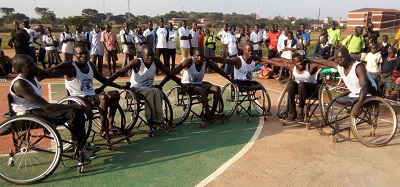
The Gala was organized by The Uganda Paralympic Committee and hosted by Gulu district. They took part in wheelchair race, wheelchair basketball and sitting volley ball.
Gulu Wheelchair Basketball Team in Action at Kaunda Ground, Gulu.
Gulu Wheelchair Basketball Club kept their national trophy by defeating arch-rivals Kampala Wheelchair Basketball Club 26-17. The exciting final of the Uganda National Paralympic Games in Wheelchair Basketball, held at Kaunda Grounds in Gulu, was witnessed by chief guest Kameda Kazuaki, the Japanese ambassador to Uganda.
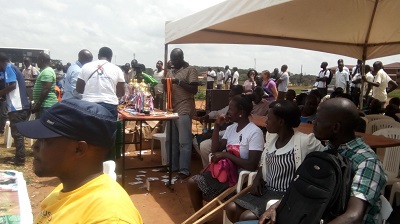
The Japanese Ambassador at National Sports Gala, Gulu.
Awarding the medals at 2017 National Disability Sports Gala in Gulu
Gulu Pwds Electronics members of that winning team were: Ojara Charles, Ocira Richard, Okwonga Charles, Akera Robert, Oloya Kenneth and Omony Patrick, congratulations to them and everyone else who took part.
During August, the ETC @ GDPU Project Officer and Project Leader followed up on business plan development, record keeping and conflict management making sure that they were being implemented by each business enterprise. A busy training programme continued and proposed activities for September look equally focused.
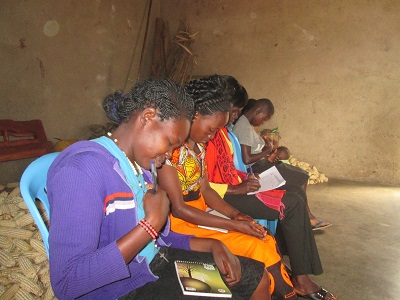
Village Savings and Loan Association pilot training session at Acet centre, Omoro District, August 2017
Training
Skills training were offered in Hairdressing, Electronic Repair and Maintenance and Knitting & Sweater Weaving in Omoro Acet Centre and Gulu Municipality targeting 4 members of NYEKO RAC HAIRDRESSING AND COSMETOLOGY, 2 members of RWOT AYE TWERO KNITTING and 6 Members of GULU PWDS ELECTRONICS REPAIR & MAINTENANCE.
Training: Village Savings and Loan Associations
Trainings in Village Savings and Loan Associations (micro finance) were carried out. VSLA pass books were distributed to the saving groups created by each enterprise to encourage the culture of savings in their enterprise.
Training: Conflict Resolution
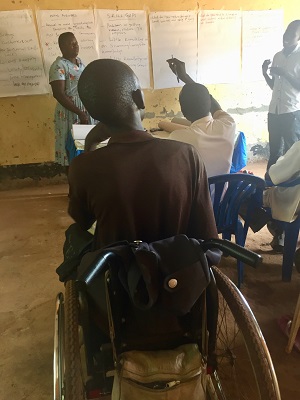
Training in Group Dynamics under Conflict Resolutions was carried out in Acet.
Group Dynamics under Conflict Resolution Training in Acet, August 2017
Challenges
But as the initial stages are completed, challenges were registered by the project officer during his visits. These were: poor attendance; high expectation for money (Especially refusal to attend meetings without payment see Sitting Fees below)); difficult attitudes; skills gaps; luck of trust from customers etc.
Challenges: Gulu
These challenges were particularly noticeable in Gulu, with high levels of absenteeism, lack of commitment to customers and work, lack of skills in: radio; TV; video decks; speakers; computer repairs. Members only specialise in phone repair which does not bring in enough income. Finding a qualified instructor to train Gulu PWDs in electronic repair and maintenance has not yet been resolved.
Akera Roberts, Individual Business Enterprise on the pilot programme, Gulu.
Although the Project Officer suggested their fellow disabled electrician (Akera Robert), who has all the skills they want, members were not interested. The P O believes that there is no unity and love among PWDs in Gulu municipality, that is the reason why most of them are not successful, because of the differences amongst them.
Gulu PWDs, Electronics and Repair: repairing a phone.
Challenges: Sitting Fees
Sitting Fees (or payment for attending trainings or meetings) are a great example of the unintended consequences of well intended actions. I believe that sitting fees were originally paid during the conflict, as a means of quickly getting money directly to those who badly needed it and bypassing those who would take a substantial cut. But now, demand for sitting fees and refusal to attend without payment is a constant problem. Most NGOs refused to pay sitting fees because the payments eat up small budgets and badly distort training sessions. The people you really need to reach either refuse to turn up or invitations are issued in turn to those who have not yet been paid a fee or to those who are powerful enough to demand that they always get one. Sessions are either taken up with endless arguments as to why participants should be paid substantial sums, or on the odd occasion where fees are paid, participants leave, in body or mind, once they have been paid because they feel their work had been done; either way nothing is achieved.
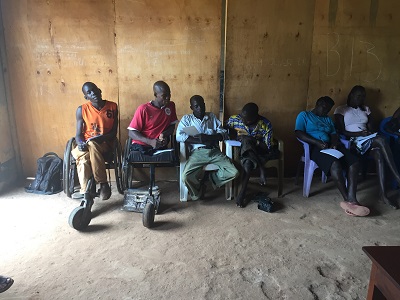
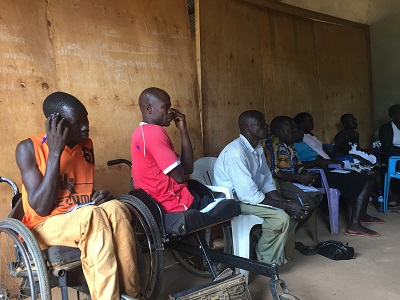
Gulu PWDs Electronics and Repair, Training at GDPU, Gulu
Challenges: Solutions?
The only surprise is that the challenges for ECT @ GDPU had not begun earlier, these are all difficulties that are common on any project of this type in this sort of context.
There is no simple solution, this culture (Sitting Fees especially) is deeply embedded and will take years to change. But we intend to try some of the approaches listed below and begin that process
Thinking about the simplest non-financial reward systems is an important part of the pilot programme. Actually, faced with this problem during the earlier Youth Development Programme we found that:
educational games
sport or other competitions
Cultural activities, eg dance and drama
and of course, food.
Were all good ways of bringing people to meetings and making them engage without concentrating solely on the money.
Regular VSLA meetings can also be a useful time to carry out training.
VSLA Training, GDPU August 2017
Challenges: Solutions/ Communications and Mentors
Group dynamics, and communication could be the key that unlocks this door.
During the VSLA sessions it was noted that members will not take leadership roles, even just for the workshop; leadership training as part of a drive to improve self-esteem might be worth following up too.
Relationship between the groups, their customers and skills trainers (especially the Gulu PWDS) are a challenge that could be met by finding the right mentors/ role models to show members where their hard work might lead to in the future. Groups need to see why they are doing what they are doing, how the rewards are not immediate but are worth waiting for; could mentors help in that aim?
Village Savings and loan Association Training at Acet center Omoro District August 2017
Conclusion
None of the challenges noted above are unusual, they are to be expected in this context and in a project of this type. There is no need to feel downhearted, it is important to remember that this is still the pilot phase, there are still opportunities to work on many different approaches and be experimental; many exciting possibilities ahead. We must keep pushing on well!
The ECT @ GDPU team have been very busy in Gulu and Acet this month carrying out the first training sessions on areas of weakness identified by the pilot groups themselves. These groups included Nyeko Rac Hairdressing and Cosmetology and 6 Members of Gulu Pwds Electronics Repair & Maintenance, Rwot Aye-Twero and Kica Pa Rwot Knitting group and some of the students studying at GDPU also attended the trainings in business plan development and conflict resolution in group dynamics.
Prayers before training begins
It is great to see that the training given directly reflects the needs identified in earlier months. Although this is a pilot, it is reassuring to see that the activities reported for July are all focused on building the participants abilities to sustain their own future.
Record Keeping Training in Gulu
As a pilot phase the July report raises questions, but these concern methods of delivery rather than direction of travel; in particular:
Group and personal dynamics are going to be the crucial element for these participants as they establish their sustainable future (low self-esteem is an important factor to work on) .
Core Skills: Building up core vocational skills alongside developing knowledge about basic business procedures is a slow process with constant reappraisal
Sweater Weaving Training; updating core skills
Memory: during the pilot, facilitators and the project team will working on the best ways for students to develop what they already know, to learn new things and most importantly, to remember what they have learnt and apply it as part of a long term process. Classes are conducted in Acholi (the local language) and texts are translated, using local knowledge; stories and culture will help ground what is learnt.
Absenteeism: a major difficulty with frequent refreshers is frequent absenteeism, so the Gulu team will be concentrating on follow up support in the workplace rather than in the classroom.
July Training in Gulu at GDPU
Mentors: The team in Gulu are looking to find role models who can talk about their enterprises to motivate members. These role models will also become part of the network that students can use on their own for further learning through mentorship, and of course students will become mentors in their own right as the project develops.
Numeracy/ Literacy: low skills in this crucial area are already holding students back, work on record keeping/ planning will demand more work on numeracy and literacy as the project develops.
Record Keeping Training in Gulu
Lastly, some other routes to sustainability, identified in the project proposals and initial audit, will be further emphasized as time goes on:
Diversification as a survival mechanism, so that if one aspect of the enterprise temporarily fails there are others that will keep it afloat;
The role of Village Savings and Loans Associations as a ‘pull factor’: keeping group members together and the single activity around which other group activities revolve. However the group numbers in our pilots are small, eg Gulu PWD electronics 6 members, and Nyeko Rac group in Odek are 5 members. As they have suggested that they need training on VSLA to increase their savings, ECT @ GDPU will support the groups in this area, perhaps joining with other interested colleagues to make a total of 10 members at minimum. VSLA groups usually meet on weekly basis to deposit savings and we think this could be a motivating factor to work harder, so that you have some saving each week.
July Training in Acet
The Future
The project team in Gulu have obviously realised these difficulties and factored in a series of follow up sessions across the range of areas identified. It will be exciting to see how these develop. Activities for August include: training in conflict resolution and group dynamics at Acet Centre; skills training in Hairdressing covering areas of Styling, Pencil, dreadlocks etc; training in electronic repair and maintenance in areas of radio, TV, phones and DVD players etc in Gulu Municipality. A busy and productive month to come: pushing on well indeed!







 ETC of PWD