We have been in contact with Gulu Disabled Persons Union (GDPU) during the lockdown. Although GDPU has been closed for most of the time, it is now starting to reopen. What follows is from the emails and messages we have had from them so far.
Persons With Special Abilities (PESA) supported deaf basketball and football players with liquid soap to help prevent the spread of Corona virus
As Ojok Patrick GDPU co-ordinator said at the start: “The time is extremely strange as we wake up everyday and you see news of people dying in large number because of the strange diseases that has attacked the world. We are all indeed trying to keep ourselves safe by staying home and not allowing neighbours and relatives to visit. Our experience with Ebola, which affected Gulu more than any part of Uganda, makes us more alert than any part of Uganda.
Some effects of the lockdown for them:
Prices of essential commodities are extremely high, partly due to supply problems and partly due to the usual profiteering.
In Gulu the government distributed food to those who only earn from hand to mouth and the most vulnerable, once. Well-wishers are also supporting people. The government advised people to go back to their villages because giving food stuffs is not the solution but farming can also help
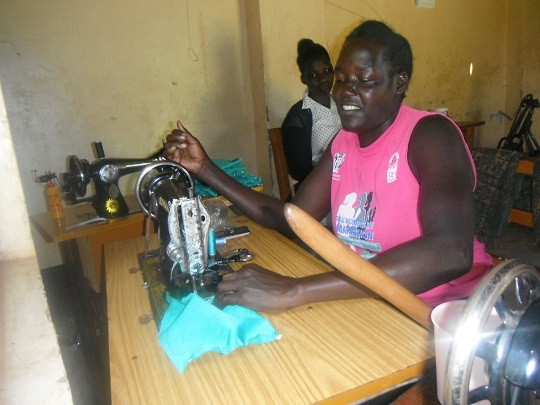
Florence at her work place making a mask
The Gulu Disabled Persons Knitting Group have been making masks, taught by their teacher Mama Cave, and selling them in town. It is from such entrepreneurship that people survive.
Cut pieces of mask
We hope to have more news of how the other ETC@GDPU business groups are doing as soon as it comes in.
As Faruk, the GDPU Guidance Counsellor and ETC @GDPU Project Officer said recently: “The government of Uganda is planning to ease the lock down starting on the 26th of this month, businesses will open, transport will be allowed with half of the capacity, school will open on the 4th of June with only finalist or candidates are expected to resume. But we are all fairing with no salaries, it’s not easy for now, hopefully if business comes back to normal then will be fine.”
20 Gulu Wheelchair basketball players received food items( beans, maize flour, liquid soap, 2 bars of soap) from Music for Reform a Youth led project
Ocholar Stephen at his repair stall at Gulu Main Market
ETC@GDPU was a support project for youth with disability who have already had some vocational training. So, the obvious next question is: what about the young people with similar needs in Gulu and surrounding area who have not been trained? The aim of the annual ETCof PWD trustees trip to Gulu and Gulu Disabled Persons Union was to pull together the last threads of that project and see what might come next.
ETCof PWD applied to DFID last year under their Small Charities Grant, although we do not have high hopes. But, as we all sat together in the GDPU board room looking at that bid, we began to put together a Plan B, a no-grant bare bones vocational training programme financed by ETCof PWD on what might raise in the UK.
The Boardroom at GDPU
GDPU ran vocational training for people with disability before, they are very keen to do so again. They have the expertise and the space. We finalised on five vocational training courses that are flexible enough to allow trainees to set up a wide range of possible sources of income:
Shamwell and Jokene from Tam Anyim Motorbike Repair Group
MCR (motorcycle repair). But a mixed course including generator/ mowing machine/ small engine repair, and some training on gas welding.
Mending the sponge on a knitting machine
Knitting (ie Sweater Weaving) handicrafts/ tailoring. The knitting machines are the problem here. If Gulu Disabled Persons Knitting Workshop can become a centre for mending them then the problem might be solved; after extra training a number of them can now repair machines if they have the parts. Sweater weaving is seasonal, GDPKW have shown that making clothes from strips of cloth for sale ready-made can work well. Ocira Brenda from the group has recently been trained in Mpigi on handicraft skills, another a possible income stream,
Handmade signboards, paid by the letter
Design and Decoration. making posters and signboards in Gulu is a good business and often carried out by the deaf. A DaD course could include design for banners/ posters/ signposts, taught by different instructors. This DaD course could be a really exciting innovation for GDPU and PWDs (persons with disabilities), but see below re. computers.
Nyeko Rach Hairdressers, Acet
Hairdressing and Salon. The DFID bid had some expensive requirements for this course, but GDPU have some equipment in stock that might bring down the price a little. And it always a good business as we have seen in Acet
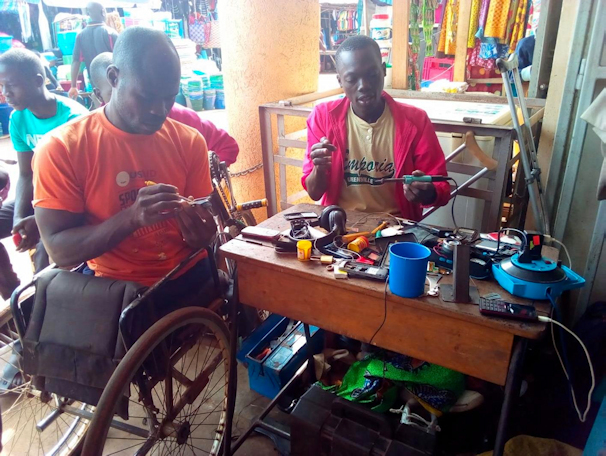
Members of Gulu PWD Electronics at their workplace in Gulu Main Market
Electronics. Phone repair of course, but also all small electronic machine repair. As Akera Robert has demonstrated there is a good market for this sort of business. The growing use of smartphones means that trainees will need to be able to mend broken screens and sockets (which are apparently the major repairs). But, this raises problems.
Computers?
With a computer element the DaD course could move into desktop publishing, the electronics group into smart phone repair, other trainees into basic PC use and for the long held plan for a business hub/ association for past GDPU trainees/ now business people? But that begs some important questions:
Funding for a computer suite?
Where to be put?
What about power outages?
Security?
Post Training Support and computers
Post Training, what access would these young businesses have to a PC? Would training on a PC only set them up to fail at the first step. Would the business hub solve this problem?
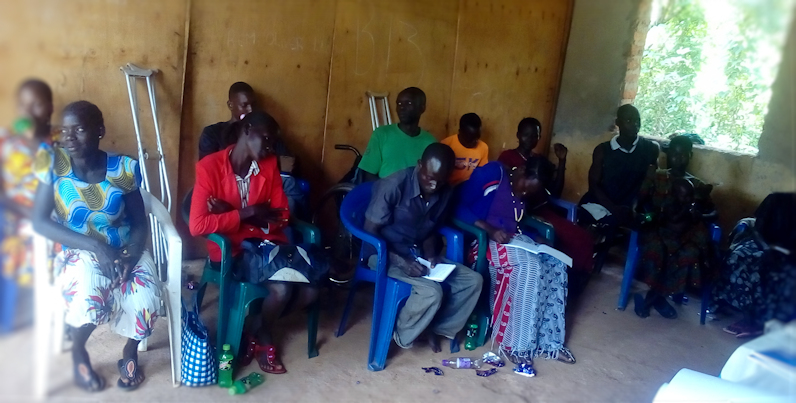
GDPU Phase Two youth groups during the Business plan training
Post Training Support
As ETC@GDPU proved, it is the Post Training support that is the key to sustainable success, including Life Skills/ Literacy and Numeracy/ Health and Sanitation/ Guidance Counselling/ Sport. These elements are probably more important than core skills training for subsequent personal development and business success. The work on extra literacy for ex-Youth Development Programme trainees in Acet for example has made a real difference.
Musema Faruk talked about running a physical literacy programme: ‘which game can you play best?’ as a way of extending the physical and therefore mental confidence of PWDs; to be included in the future programme.
As well as the usual elements of Dance/Music/ Drama and Debate. Given that many of the ETC@GDPU trainees are now looking to politics to improve their lot and that of their fellows, some teaching about governance etc would be useful. All of these inclusions have cost and timing implications for any course structure.
Learning to make clothing at Gulu Disabled Persons Knitting Workshop
Exciting possibilities and some very big questions to answer, mostly solved with finance which begs the most important question of all: how will we pay for all this?
The ETC@GDPU project is drawing to a close. It was set up to give support to young people with disability who had already received some vocational training and had started their own business. As we all know, in any context, those first years of running your own business, earning your own living are hard, you need support, be it extra core skills training, maybe literacy or numeracy training or even just advice. That’s what this project gave, via project officers from Gulu Disabled Persons Union, where all the trainees gained their initial vocational training under the DFID sponsored Youth Development Programme some years ago.
ETC@GDPU project Officers Musema Faruk and Ajok Emma with GDPU Co-ordinator Ojok Patrick
The final evaluations and assessments are just getting going, but visiting the groups and individuals on the annual trustees visit to Gulu made certain things clear. Three headings: Consultation; Flexibility; Sustainability.
Adult Literacy Training in Acholi
Consultation: different people in different situations have different needs to get their business going. Asking people what they need rather than telling them what they’re going to get, well that’s always a good idea isn’t it?
Generator training in Koch Goma
Flexibility: from the consultation you find out things like, motorbike repairers outside the town could have a range of options for other small machines to mend, adding significantly to income. We subsequently organised training in repairing generators/ strimmers/ etc. Talking to groups in Cwero and Koch Goma this year, we found that they were now building up a good business repairing small machines.
Sweater Weavers, one knitting and one making clothes
Sweater weaving work is seasonal, based around the start of the school year, learning other forms of making, ready made dresses for children for example brings income at other times.
The machines break easily, we have paid for Mama Cave, an instructor, to train up sweater weavers in basic machine repair so that their production does not stop at key times.
Ajok Emma ETC@GDPU Project Officer and Mama Cave Knitting Instructor
Hairdressers out of town need to know what the new styles will be, and how to make them. All small steps, but important ones.
Sustainability: once you establish that free cash and materials are out of the question, trainees know that their efforts must keep them afloat. In the jargon, they become ‘empowered’ and the ETC@GDPU project officers will support and train that ‘empowerment’. So many previous development programmes in Gulu have not lasted because people, based on past experience, become serial beneficiaries. Waiting for the next programme to give you money and more materials, which you can sell as you wait for the next, and so on. “Our people must not be beggars” we are told often by other PWDs.
What has been noticeable this year, is that many of the people in this programme have built on their own self confidence to become politically active, getting elected and involved in improving their own lot and that of their fellows; true empowerment.
Akera Robert in his new shop
We still haven’t got trainees to keep record books, or planning on paper. But look at the success of someone like Akera Robert. Last year he told us that he would move away from working on a veranda on the street, and yes, he has; so many congratulations to him. He has a shop, a house, his child is at one of the best schools – all through his own efforts – and he helps other trainees when they get stuck with technical issues; a star.
Jokene from Tam Anyim motorbike repair group going through final assessment forms with Ajok Emma
Or look at the team at Tam Anyim. the combination of motorbike and small machine repair and taking in students of their own means that Jokene (one of the two that runs the group) can now send his own child to school – a very important measure of success here. They also think they can put up a new building behind their existing workshop to expand the business; equally impressive and all plans kept in his head of course.
Through the ETC@GDPU project everyone has learnt a great deal about how to develop post training support that works and will last. Now that this project is ending, how can we use all this knowledge? See the next newsletter to find out. We welcome individual donations, please visit our donations page.
How are things pushing on at GDPU (Gulu Persons Disabled Union) and for the young businesses being supported there?
Gulu versus Kampala in the Paralympic games at Mpigi
Sport and or Work?
Exciting times for the Gulu Wheelchair Basketball Club, they soundly beat the Kampala team at the National Paralympic games in Mpigi in September and, after training in Kampala will go on to the East African games in Nairobi at the end of October. The Gulu team go from strength to strength. However, for those team members who are part of the Gulu PWD electronics group it means their businesses as repairers of phones are on hold again.
Gulu PWDs Electronics: at work
After all, in the choice between sport and work, sport is always going to win isn’t it? Especially if you are young and nationally and, we hope, internationally successful.
Project Officers
In other great news, Faruk the ETC@GDPU Project officer and GDPU guidance Counsellor was accepted onto a training course with the Kanthari Institute (“Scholarships for social change makers”) in Trivandrum, India earlier this year. A wonderful opportunity for him to work on his proposals for disabled sports and schoolchildren; very exciting.
Emma Okello with GDPKW members and some of the sweaters for Layibi College
In his absence we have a new project officer Emma Okello. She has been working very hard, supporting the business groups and organising new training in financial skills, literacy and numeracy and generator and small machines repair for the motorbike groups.
Literacy Implications
Nyeko Rach with Okumu Morris and Emma Okello
Okumu Morris has continued Financial Training all the groups, record keeping; savings; micro finance; access to credit and so on. He has faced the normal challenges (the babies in the room are not that keen on finance apparently), but the biggest challenge is the trainee’s basic literacy levels. There is a strong link between low literacy and retention levels; improving literacy improves students’ ability to remember what they have leant and to apply that learning away from the classroom.
Literacy training in Luo
Many of the groups have already had basic literacy training in English and Luo the local language, more is clearly needed. Nyeko Rach, the hairdressers group in Acet, have asked for extra literacy lessons for exactly this reason.
Nyeko Rach members training at GDPU
One of the hairdressers is profoundly deaf, and getting a signing interpreter out to Acet at the same time as the literacy teacher (neither skills exist in Acet itself) has been complicated. We think we’ve solved that now, although transport out to Acet on a murrum road during the rains is tricky
Peer to peer lending and developing businesses.
GDPKW: making the sweaters for Layibi College
Developing a business is a slow process. Once you get that first big order, as Gulu Disabled Persons Knitting Workshop did, with an order to knit hundreds of sweaters for nearby Layibi College, it is still not easy. How do you buy in the materials you need to fulfil your first big order when you have no money, no bank account, no credit history and no access to credit? Emma Okello, the new ETC of PWD project officer was able to organise a short-term loan from the Gulu Wheelchair Basketball Club to the knitters. Peer to peer lending, as it is known, could be a good way to go in the future.
Training at GDPKW
GDPU was also able to help with initial negotiations between the knitters and the college, to bank payment cheques as they came in and transfer money out to buy material. Emma will now support the group as they open their first bank account, making sure that some of the money will be retained for the repair of the all–too delicate knitting machines. We have also arranged that the group will be trained in basic machine repair, so that they can be kept in working order.
What next? There are other challenges that come with success. Whilst you work flat out to bring in your first major order, you forget about future work. Emma is helping Gulu Disabled Persons Knitting Workshop think about where the next orders should come from and where diversifying might take them.
Generator training.
Generator Training at Koch Li with the Lubanga Lakija group
Our discussions with repair groups during this February’s trustees visit, emphasised that the different context of town and village means different machines to fix, and therefore different training regimes for trainees. Some, like Akera Robert the electronics repair man, have used this difference to their advantage. He works on small scale electronics from a veranda in Gulu town, often with his original teacher. Robert can rely on a steady supply of portable repairs coming in on the buses from out of town for him to mend; a clever solution.
Akera Robert at work on a veranda in Gulu Town
But others need support, so Emma has arranged for instructors to go out from Gulu to Paicho and Koch Li to train the motorbike groups in generator, small machine and different motorbike repairs. She reports that new work is now coming in
Tam Anyim in Paicho with Emma, training on a grass slasher
After our visits to business enterprises in Gulu, Paicho, Acet and Koch Li, our meeting in Gulu with GDPU included the Chairman of the Board, the Treasurer the GDPU Co-ordinator and the Project Officer.
It was a genuinely productive discussion about what we have all learned so far and where the ETC@GDPU project might go next.
GDPU is keen to set up again as a training hub for Persons with Disability, this will not only provide a route to sustainability for trainees, but bring an income in for the institution itself
Sample Cash Book from a Training Session
Investment: Literacy and numeracy, sustainability and habituation
As we saw in our field visits, groups and individuals need to understand how and why to invest in their own businesses (and how to search for other forms of funding) if they are to develop and to reach their sustainable aim. What holds them back?:
Low literacy and numeracy skills are one element. Few, despite training and support, have working record books/ records to help analyse success and aid planning; although there is far more to this issue than that. If all transactions are very small amounts of unrecorded cash, it dissapears quickly.
Business Training
Low self-esteem is certainly part of the mix.
Store keeping
Life events; it is a vulnerable and precarious life with no safety margins. Common events like a bout of malaria for instance or a family funeral, will wipe out any savings instantly. Insecurity is rampant, if you are successful someone will prey on you, if you are unsuccessful, even more so.
Members of Rwot Aye Twero Sweater weaving group discussing the future
The familiar problem of what you could call ‘habituation’. Beneficiaries who have been through constant development cycles often expect that someone else, i.e. ‘The Whites’, will just turn up and give them the money they want to solve short term problems or give them materials that can be sold for money. After all this is what has happened in the past, and most vulnerable people in these circumstances expect the pattern to repeat, so they wait for it. For example, the constant poor electricity supply badly affects mobile phone repairers. A portable solar system would solve these problems for the Gulu PWDs enterprise, but some members refuse to pay anything towards it and all of their income has more or less collapsed.
Conflict Resolution Training Session at GDPU
Habituation and financial support for groups
The’ habituation’ challenge has been built in our programme planning. The new trustees asked whether we should we be providing capital funds for groups. It is a legitimate question but we have never done this in the past, deliberately. ETC of PWD has always believed that it is skills training, support and monitoring that make the difference, cash and materials handouts cause more short and long term problems than they solve. The GDPU board firmly agreed on this point, they stated quite strongly that it would be better to:
Link the groups with existing structures
Help them to fill in forms to access other funding; local and government grants for PWDs do exist.
Develop confidence in themselves.
Ocholar Stephen and Okwonga Charles at their work station outside Gulu Main Market
If GDPU is to become a training hub again, what courses should it run?
A productive discussion about which courses would be most suitable, particularly noting the difference for urban/ rural training needs; market requirements are different between Gulu and outlying areas.
Electronics/ phone repair?
Although a popular course with students it is high risk. Changing technology means that people increasingly use smart phones, they are harder to repair than the simple feature phone on which previous students were trained; current and future PWD enterprises will be left out of this market. Lots of expensive software and hardware is needed, the expenses and demands will only get greater as technological complexity increases. Training in smart phone repair is currently beyond the potential of available trainers to offer and of any small institution to support, and will not get any easier.
MCRM in the country, members of Lubanga Lakica with Ongom Simon (Councillor and Chairman of GDPU Board)
Courses with different modules offering students the ability to diversify
For example, future skills training for motor cycle repair and maintenance (MCRM) workers going out to the villages should include: training in small motors eg: slashing machines; generators; milling machines etc. Whereas urban MCRM trainees will need to know how to mend a range of bikes (eg Yamaha) that are increasingly common in town but which never get out into the country.
Jokene from Tam Anyim working on a Bajaj Boxer and Yahama 125 at the same time
Peer to peer training/ On the Job training and training others.
What is the quality of the training that these peer trained trainees receive?
In the future should GDPU give training modules on training the trainer?
Should the project officer be monitoring the quality of peer to peer training?
Joining a sweater using a machine, after training. Notice the two broken sweater weaving machines in the background.
Conclusion: pilot training courses –
It was agreed that it would be a good idea to develop and run a pilot in 2 areas, which could also make for relatively even gender coverage. It was agreed that GDPU should focus on developing training programmes for:
Motor cycle repair and maintenance/ agricultural and small machinery with suitable training in diversity for students from town and country
Knitting /tailoring and upcycling with a very strong focus on diversifying away from the sweater weaving machines and all their associated problems.
Sweater Weaving Machine Head, Acet
Knitting machine technician
GDPU should also try to train up a knitting machine technician for the whole area.
Peer to peer training
Modules should be developed within each core skill training programme that can begin to help trainees to deliver meaningful training to other PWDs in the future.
Project Officer Musema Faruk with Ocholar Stephen
How long should post training support last?
GDPU groups have succeeded and have lasted longer than other Youth Development Programme business groups because GDPU still has contact with them, they are family and still looked after. Six month post training support on the earlier YDP programme was too short; ECT has supported post YDP business groups for over two years and it is only now starting to bear fruit. So any future training programmes must involve long post training support proposals.
GDPU Co-Ordinator, Ojok Patrick with Akera Robert
Next Steps
Ongoing support for existing groups
ETC @GDPU agreed to continue low level support to all existing groups (Phase 1 and 2), support tailored to each group. Faruk is still the person who is in contact and has the guidance experience. ETC can just about fund this from existing resources.
GDPU proposal
GDPU to provide a proposal and further discussion on the resources required to start the training pilot. GDPU to amend current proposals to develop programme and costings
Motorbike repair in Paicho
Loans and grants
ETC trustees will try to carry out fundraising for these new courses and will research possible future funding streams and how to apply for them.
Safeguarding
The meeting finished with further reminders of the importance of safeguarding beneficiaries, staff and all those who might be vulnerable and that come into contact with GDPU.






 ETC of PWD