Pushing on well: what has been learned

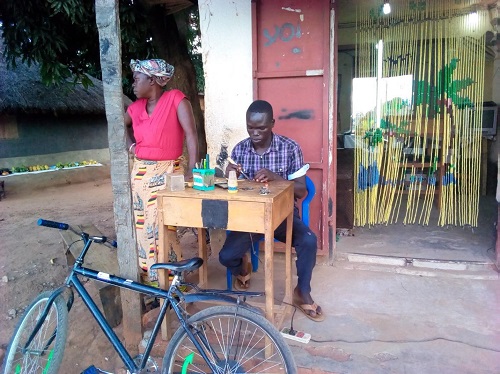
Cereleno Market, Gulu

The ETC@GDPU project is drawing to a close. It was set up to give support to young people with disability who had already received some vocational training and had started their own business. As we all know, in any context, those first years of running your own business, earning your own living are hard, you need support, be it extra core skills training, maybe literacy or numeracy training or even just advice. That’s what this project gave, via project officers from Gulu Disabled Persons Union, where all the trainees gained their initial vocational training under the DFID sponsored Youth Development Programme some years ago.

ETC@GDPU project Officers Musema Faruk and Ajok Emma with GDPU Co-ordinator Ojok Patrick

The final evaluations and assessments are just getting going, but visiting the groups and individuals on the annual trustees visit to Gulu made certain things clear. Three headings: Consultation; Flexibility; Sustainability.

Adult Literacy Training in Acholi

Consultation: different people in different situations have different needs to get their business going. Asking people what they need rather than telling them what they’re going to get, well that’s always a good idea isn’t it?

Generator training in Koch Goma

Flexibility: from the consultation you find out things like, motorbike repairers outside the town could have a range of options for other small machines to mend, adding significantly to income. We subsequently organised training in repairing generators/ strimmers/ etc. Talking to groups in Cwero and Koch Goma this year, we found that they were now building up a good business repairing small machines.

Sweater Weavers, one knitting and one making clothes

Sweater weaving work is seasonal, based around the start of the school year, learning other forms of making, ready made dresses for children for example brings income at other times.

The machines break easily, we have paid for Mama Cave, an instructor, to train up sweater weavers in basic machine repair so that their production does not stop at key times.

Ajok Emma ETC@GDPU Project Officer and Mama Cave Knitting Instructor

Hairdressers out of town need to know what the new styles will be, and how to make them. All small steps, but important ones.

Sustainability: once you establish that free cash and materials are out of the question, trainees know that their efforts must keep them afloat. In the jargon, they become ‘empowered’ and the ETC@GDPU project officers will support and train that ‘empowerment’. So many previous development programmes in Gulu have not lasted because people, based on past experience, become serial beneficiaries. Waiting for the next programme to give you money and more materials, which you can sell as you wait for the next, and so on. “Our people must not be beggars” we are told often by other PWDs.

What has been noticeable this year, is that many of the people in this programme have built on their own self confidence to become politically active, getting elected and involved in improving their own lot and that of their fellows; true empowerment.

Akera Robert in his new shop

We still haven’t got trainees to keep record books, or planning on paper. But look at the success of someone like Akera Robert. Last year he told us that he would move away from working on a veranda on the street, and yes, he has; so many congratulations to him. He has a shop, a house, his child is at one of the best schools – all through his own efforts – and he helps other trainees when they get stuck with technical issues; a star.

Jokene from Tam Anyim motorbike repair group going through final assessment forms with Ajok Emma

Or look at the team at Tam Anyim. the combination of motorbike and small machine repair and taking in students of their own means that Jokene (one of the two that runs the group) can now send his own child to school – a very important measure of success here. They also think they can put up a new building behind their existing workshop to expand the business; equally impressive and all plans kept in his head of course.

Through the ETC@GDPU project everyone has learnt a great deal about how to develop post training support that works and will last. Now that this project is ending, how can we use all this knowledge? See the next newsletter to find out. We welcome individual donations, please visit our donations page.

Back to Gulu part two: Annual Trustees Meeting

Camera 360
Gulu Disabled Persons Union Offices

Gulu Disabled Persons Union Meeting

After our visits to business enterprises in Gulu, Paicho, Acet and Koch Li, our meeting in Gulu with GDPU included the Chairman of the Board, the Treasurer the GDPU Co-ordinator and the Project Officer.

It was a genuinely productive discussion about what we have all learned so far and where the ETC@GDPU project might go next.

GDPU is keen to set up again as a training hub for Persons with Disability, this will not only provide a route to sustainability for trainees, but bring an income in for the institution itself

Sample Cash Book from a Training Session

Investment: Literacy and numeracy, sustainability and habituation

As we saw in our field visits, groups and individuals need to understand how and why to invest in their own businesses (and how to search for other forms of funding) if they are to develop and to reach their sustainable aim. What holds them back?:

  • Low literacy and numeracy skills are one element. Few, despite training and support, have working record books/ records to help analyse success and aid planning; although there is far more to this issue than that. If all transactions are very small amounts of unrecorded cash, it dissapears quickly.

    Business Training 2
    Business Training
  • Low self-esteem is certainly part of the mix.

    Camera 360
    Store keeping
  • Life events; it is a vulnerable and precarious life with no safety margins. Common events like a bout of malaria for instance or a family funeral, will wipe out any savings instantly. Insecurity is rampant, if you are successful someone will prey on you, if you are unsuccessful, even more so.

    Rwot Aye Twero discussing the future
    Members of Rwot Aye Twero Sweater weaving group discussing the future
  • The familiar problem of what you could call ‘habituation’. Beneficiaries who have been through constant development cycles often expect that someone else, i.e. ‘The Whites’, will just turn up and give them the money they want to solve short term problems or give them materials that can be sold for money. After all this is what has happened in the past, and most vulnerable people in these circumstances expect the pattern to repeat, so they wait for it. For example, the constant poor electricity supply badly affects mobile phone repairers. A portable solar system would solve these problems for the Gulu PWDs enterprise, but some members refuse to pay anything towards it and all of their income has more or less collapsed.
Training Session at GDPU resized
Conflict Resolution Training Session at GDPU

Habituation and financial support for groups

The’ habituation’ challenge has been built in our programme planning. The new trustees asked whether we should we be providing capital funds for groups. It is a legitimate question but we have never done this in the past, deliberately. ETC of PWD has always believed that it is skills training, support and monitoring that make the difference, cash and materials handouts cause more short and long term problems than they solve. The GDPU board firmly agreed on this point, they stated quite strongly that it would be better to:

  • Link the groups with existing structures
  • Help them to fill in forms to access other funding; local and government grants for PWDs do exist.
  • Develop confidence in themselves.
Ocholar Stephen and Okwonga Charles at their work station 2
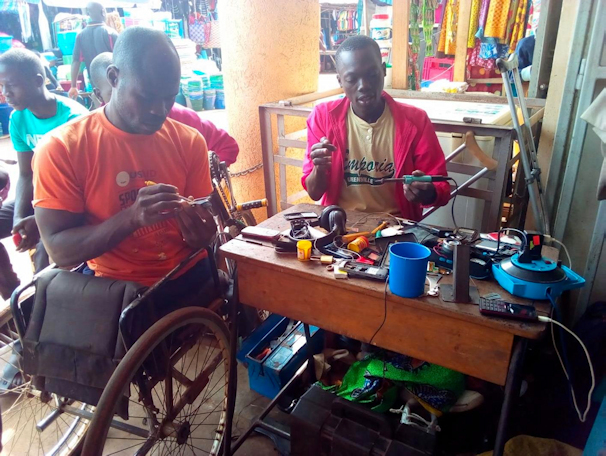
Ocholar Stephen and Okwonga Charles at their work station outside Gulu Main Market

If GDPU is to become a training hub again, what courses should it run?

A productive discussion about which courses would be most suitable, particularly noting the difference for urban/ rural training needs; market requirements are different between Gulu and outlying areas.

Electronics/ phone repair?

Although a popular course with students it is high risk. Changing technology means that people increasingly use smart phones, they are harder to repair than the simple feature phone on which previous students were trained; current and future PWD enterprises will be left out of this market. Lots of expensive software and hardware is needed, the expenses and demands will only get greater as technological complexity increases. Training in smart phone repair is currently beyond the potential of available trainers to offer and of any small institution to support, and will not get any easier.

MCRM in the country
MCRM in the country, members of Lubanga Lakica with Ongom Simon (Councillor and Chairman of GDPU Board)

Courses with different modules offering students the ability to diversify

For example, future skills training for motor cycle repair and maintenance (MCRM) workers going out to the villages should include: training in small motors eg: slashing machines; generators; milling machines etc. Whereas urban MCRM trainees will need to know how to mend a range of bikes (eg Yamaha) that are increasingly common in town but which never get out into the country.

Jokene from Tam Anyim working on a Bajaj Boxer and Yahama 125 at the same time

Peer to peer training/ On the Job training and training others.

It was noticeable, visiting groups in the field recently, that many of the members were training other youth. This raises a series of questions:

  • What is the quality of the training that these peer trained trainees receive?
  • In the future should GDPU give training modules on training the trainer?
  • Should the project officer be monitoring the quality of peer to peer training?
Joining a sweater using a machine, after training.
Joining a sweater using a machine, after training. Notice the two broken sweater weaving machines in the background.

Conclusion: pilot training courses –

It was agreed that it would be a good idea to develop and run a pilot in 2 areas, which could also make for relatively even gender coverage. It was agreed that GDPU should focus on developing training programmes for:

  1. Motor cycle repair and maintenance/ agricultural and small machinery with suitable training in diversity for students from town and country
  2. Knitting /tailoring and upcycling with a very strong focus on diversifying away from the sweater weaving machines and all their associated problems.
Sweater Weaving Machine Head Acet
Sweater Weaving Machine Head, Acet

Knitting machine technician

GDPU should also try to train up a knitting machine technician for the whole area.

Peer to peer training

Modules should be developed within each core skill training programme that can begin to help trainees to deliver meaningful training to other PWDs in the future.

Project Officer Musema Faruk with Ocholar Stephen Ocholar Stephen
Project Officer Musema Faruk with Ocholar Stephen

How long should post training support last?

GDPU groups have succeeded and have lasted longer than other Youth Development Programme business groups because GDPU still has contact with them, they are family and still looked after. Six month post training support on the earlier YDP programme was too short; ECT has supported post YDP business groups for over two years and it is only now starting to bear fruit. So any future training programmes must involve long post training support proposals.

Camera 360
GDPU Co-Ordinator, Ojok Patrick with Akera Robert

Next Steps

Ongoing support for existing groups

ETC @GDPU agreed to continue low level support to all existing groups (Phase 1 and 2), support tailored to each group. Faruk is still the person who is in contact and has the guidance experience. ETC can just about fund this from existing resources.

GDPU proposal

GDPU to provide a proposal and further discussion on the resources required to start the training pilot. GDPU to amend current proposals to develop programme and costings

MCRM in Paicho
Motorbike repair in Paicho

Loans and grants

ETC trustees will try to carry out fundraising for these new courses and will research possible future funding streams and how to apply for them.

Safeguarding

The meeting finished with further reminders of the importance of safeguarding beneficiaries, staff and all those who might be vulnerable and that come into contact with GDPU.

GDPU Offices 2

How have they been pushing on at GDPU?

Jokene Geoffry of Tam Anyim Youth Entereprise working on his business plan
Jokene Geoffry of Tam Anyim Youth Enterprise working on his business plan

Any further sporting achievements to celebrate?

Members of Gulu PWDs electronics went to the national competition in Mbarara in September with great results.

other01pix
Ocira Richard

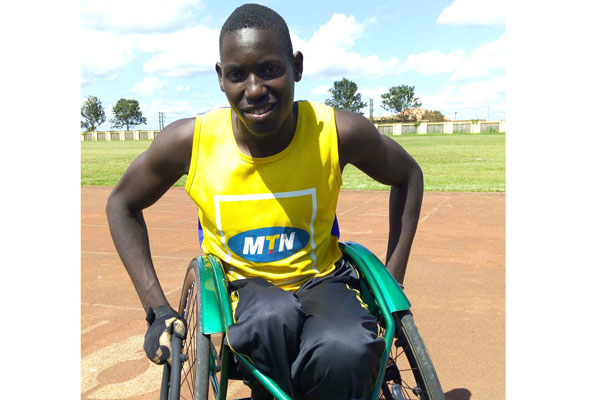
Ocira Richard, a member of the group, won the National Wheelchair 100 metres in Mbarara and has now gone to Berlin to represent Uganda in the Wheelchair Marathon, the first ever Ugandan to represent his country in this way; we all wish him the very best!

Ocholar Stephen July 1
Ocholar Stephen with Musema Faruk (ETC@GDPU Project Officer)

We are also very happy to see that Musema Faruk’s (the ETC@GDPU Project Officer) work coaching children in inclusive disability sports has been recognized. He has been shortlisted for Arsenal, WorldRemit Coaching Programme launched last month to offer local coaches from across Africa a place on a training camp with Arsenal’s Schools coaches in London; all the very best for that too Faruk!

In other news, Enhancing the Capacity of Persons with Disability (ETC of PWD), the umbrella group that includes the ETC@GDPU project, has now been fully registered as a charity in the UK. Which means of course, that once HMRC have finally approved our financial status as a charity we can start looking for funding; expect all sorts of demands soon. The Charities Commission have asked that we make each part of the programme clearly separate, so a new ETC of PWD website will be appearing in the near future.

GDPU Phase Two youth groups during the Business plan training
Phase Two youth groups during the Business Plan training at GDPU

What else has been happening at Gulu Disabled Persons Union?

After the evaluation of the successful ETC@GDPU pilot phase we all decided that:

  1. the project and its aims were worthwhile,
  2. that Gulu Disabled Persons Union (GDPU) should continue to keep an eye on the existing pilot phase groups
  3. GDPU should look to the past Youth Development Programme groups to find more young persons with disability in Gulu and district who would benefit from support in their businesses.
GDPKW SWEATER KNITTING ENTERPRISE (4)
Gulu Disabled Persons Knitting Workshop

We are now properly into Phase 2 of the ETC@GDPU Programme, Musema Faruk, the ETC@GDPU project Officer has found four groups:

  • Gulu Disabled Persons Knitting workshop
  • Hope for Disabled Girls (hairdressing)
  • Lubanga Lakija (Motor cycle repair and maintenance)
  • Tam Anyim (Motor cycle repair and maintenance)

And two individual enterprises:

  • Ocholar Stephen (Electronics)
  • Oloya Kenneth (Electronics)
Members of lubanga lakica Enterprise Developing their Business plan
Members of Lubanga Lakica Enterprise developing their Business Plan

Faruk has now worked with each one to find out what they want to do to improve their businesses and what skills they would like to improve, found new trainers where appropriate and assessed the level of support each enterprise will need.

As Phase 2 begins, he has worked with them on their financial structures, Ojok Patrick (Project Leader and GDPU co-ordinator) has worked with them all on group structures and conflict resolution. Courses have been delivered on literacy, numeracy and sanitation. As before, this support will continue for the next eight months.

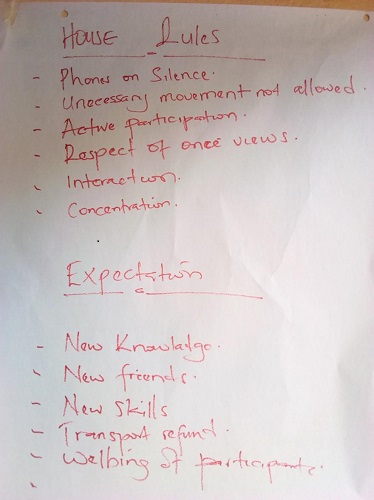
House rules and expectations for all participants
House rules and expectations for all participants during training

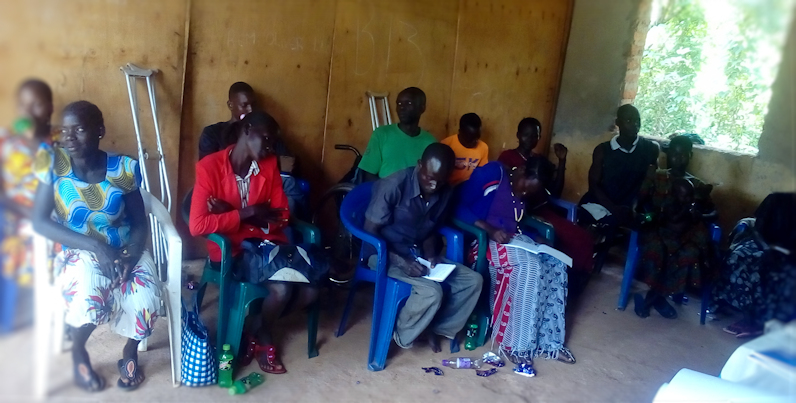
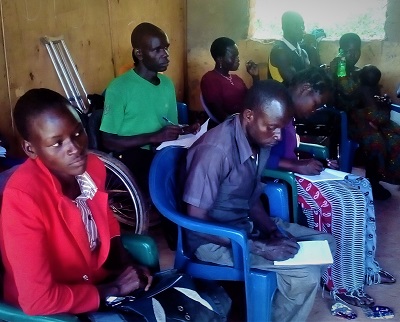
Business Plan Training

The usual conversations about facilitation (money for attending a session) with participants, we realise that members find difficulties with transport and time training is not time spent earning: “I spend my day here how will I survive in the evening?”

Discussion on how to make a record book according to their knowledge

As Faruk says: “With facilitation, members are active, without they are dormant”. But we also know that if people are given money to attend then they do not take up the skills on offer, they feel that by merely attending they have earned their money. So, the current process is to give money for transport and lunch and then it all depends on the quality of the training to inspire the activity of the participants. As an experiment, each member is given 5 thousand shillings by Faruk for facilitation but of that, 1 thousand must go into the group account to get into the idea that each must contribute from their own funds.

The members coped with the business template. They brainstormed in their groups. It is better for them to do the plan as part of their training and so now they have a working business plan for their group.

Business Plan Training

They have already carried out record keeping workshops and been given a book, a calendar and a calculator and they had drawn up their record books themselves to their own specifications.

Carrying out Financial Literacy training one week later allowed Faruk to find out their knowledge and he now knows the gaps and what kind of training each group needs and so can put together a training plan for each group.

Hope for Disabled Girls

So far, Faruk feels that the group needing the most support will be Hope for Disabled Girls: “this youth enterprise consisted of 7 females, their plans for a kiosk in a strategic location were denied by Pece Division Authorities which left the enterprise members stranded. The enterprise still lacks many of qualities and skills needed to operate successfully in the community. ETC@GDPU will try to mentor them to a level that they can become sustainable and strong.”

Oloya Kenneth at his workshop 2
Oloya Kenneth at his workshop

The strongest enterprise is probably Aloya Kenneth who is an ambitious, hardworking and skilful young man with thriving business in a good location, support will mostly be for extra skills training and how to find sources of investment.

There is a full breakdown and assessment of each Phase 2 group here.

Rwot Aye Twero Phase 2 July 3
Training at Rwot Aye Twero

And how are the Pilot Phase Groups pushing on?

Rwot Aye Twero Knitting Group

They are in Acet Trading Centre, a hard to reach area in Omoro District. This enterprise has two members who are actively knitting sweaters, although they still have gaps that need to be filled. In particular, joining the sweaters they have knitted and also making open sweaters as they are a design which is more marketable in their area.

Rwot Aye Twero Phase 2 July 1
Mama Cave training at Rwot Aye Twero

The group has identified an instructor they trust and she has started training them in gaps they have. The ETC@GDPU project supported 50% of the training, ETC project supported 50% because of the cost sharing policy of the project, which is aimed at involvement of the teams to register a sustainable development for the enterprise.

Meeting With Nyeko Rach Hairdressers Acet 5
Nyeko Rach Hairdressers, Acet

Nyeko Rach

Hairdressers group, also in Acet. They are doing well, they call every week for transporting chemicals as there is no shop there. They are very active and every week a car is sent with materials for them.

Gulu PWDs Electronics July 4
Gulu PWDs Electronics at work

PWD electronics

Charles from PWD electronics is still getting training from former PWD Electronics member Akira Robert, in fact whoever wants more knowledge can attend open training with him on Monday and Thursday. Akira Robert is eager to support his fellows and always keeps to time.

People have confidence with all of them, they don’t see their disability just people who can repair. Ocira Richard has not got his software yet, he is very active in his sport

Customers waiting for their appliances They do repair in the presence of their customers
Customers waiting for their appliances; They repair in the presence of their customers

More sport?

They participated in a marathon that was organized by Omoro District local government in celebrating the world population day. The winner of the marathon was Ocira Denis who received a Blanket and a Tailoring Machine and the second runner up was Ojara Denis who also received a blanket. Although they still haven’t sorted out their book keeping yet.

Back to Gulu: Pilot Phase Evaluation


GDPU Offices 2
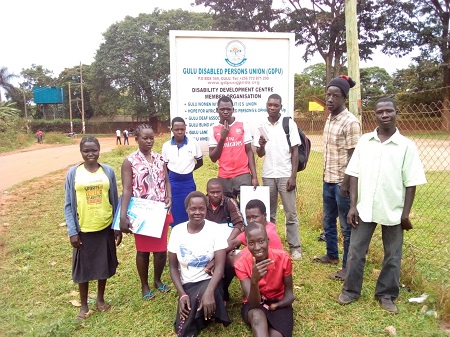
Gulu Disabled Persons Union Offices, looking towards the road

Recently, at Gulu Disabled Persons Union itself, we sat down with Ojok Patrick (Gulu Disabled Persons Union co-ordinator and ETC at GDPU Project Leader) and Musema Faruk (ETC at GDPU Project Officer) to discuss the end of the Pilot Phase. From a snowy UK and temperatures well into the minus to 37 degrees in dusty Gulu, Northern Uganda, but it was wonderful to be back with the team.


The Donor Board at GDPU
Musema Faruk at the donor board at GDPU

The basic aim of the ETC project is twofold:

  1. To ensure the sustainability of those businesses set up by disabled students under the earlier Youth Development Programme. Experience on that programme had taught us that hard inputs (cash, materials, machines etc) were unproductive, students needed skills training, psycho social support, monitoring and guidance far more.
  2. To help GDPU become a business hub for people with disability in the area, through gaining new knowledge, skills and materials from the external experts/consultants contracted to support ETC, and through making a workable development plan.
Musema Faruk and Mary Bennell outside GDPU 3
Musema Faruk and Mary Bennell outside GDPU

When we sat down to look back at the pilot project and last six months or more, we wanted to think about the two outcomes of the project and certain issues in particular:

Outcome 1: Working with ex- YDP students

  • Did the initial assumptions about planning the project work, ie that beneficiaries would know best what sort of training and support they needed.
  • Had the subsequent skills training and support been successful?
  • What does success look like and had the four groups we had chosen for the pilot achieved it?
  • And most importantly: what next?

Outcome 2: GDPU Business Hub

  • Had GDPU managed to start writing a business plan for themselves
  • Had people at GDPU developed their own skills so that they could train others? If so in which areas and which still need development?
  • And of course; what next here as well?


GDPU Offices from the road

This first meeting was just to get everything going, the next step was to go out to the field. To meet the four pilot groups again, to see how they were doing in Gulu Town and Acet. Then we would get together again to discuss what we had seen and to work on the Pilot Evaluation report that had been prepared by a local consultant. All that in the next blog.

Acholi Road Gulu
Off to the field: Acholi Road, Gulu

Next Steps: ETC@GDPU in October; why fixing the gaps matters and more excitement from Gulu PWD Athletes

The start of the wheelchair road race, Kampala

Breaking News

As I was writing this report, Faruk (the ETC@GDPU project officer) emailed us to say that Gulu PWD Athletes have been in the national news again, this time for a major wheelchair marathon.

On 12th November, two members of the ETC@GDPU pilot group: Gulu PWD Electronics, competed in the MTN and UAF Wheelchair and Tricycle 10km road race in Kampala. It was a nail biting finish, after leading the pack Ocira Richards was only beaten into second place because he came off at the last bend in very slippery conditions, Okwonga Charles also finished well, coming fifth. You can read more about the race here; our heartiest congratulations to them both; first and second places next year we hope!

The start of the 10k wheelchair road race, Kampala

Next Steps for October: Training News, ‘fixing the gaps’ and future planning

Highlights of the month

  • Analysis of the Reflection Meeting in September leads to extra business training for pilot groups.
  • Further evidence that the pilot programme has worked and members income has increased
  • Monthly follow up activities and decisions to make about the future
The ETC@GDPU Project Officer Fact Finding in Acet

Training in Business Management and Book Keeping/Record Keeping

The recent training programme at the ETC@ GDPU project shows the importance of ‘reflection’ meetings with the people you are training. After those meetings in September the ETC@GDPU Project Officer realised that one of the most important areas identified as gaps needed attention.

Where was that gap?

It was in Basic Book Keeping and Business Management

Why does that matter?

Unsuccessful training in business management and record keeping was one of the areas that caused poor sustainability amongst the earlier YDP youth enterprises.

Why?

Because they failed to analyse their profit margin, members didn’t know how much they were spending on materials and because they didn’t keep other records for their businesses, they didn’t know how much money, if any, they were making. Therefore, members didn’t know which areas of their business were successful or unsuccessful. The young enterprises cannot plan, develop or even understand their own business without such basic information.

Reflection Meeting in Gulu

Aim of the extra support training

to help strengthen and develop the business enterprise by the end of November.

What did ETC@GDPU do?

GDPU Identified KENVIC CONSULTANCY Firm and the expertise of the GDPU accountant to train these youth in areas of Business Management and Book Keeping/Record Keeping.

Business Management Training

The training was conducted successfully in Omoro Acet Centre and Gulu Municipality targeting 4 members of NYEKO RAC HAIRDRESSING AND COSMETOLOGY, 2 members of RWOT AYE TWERO YOUTH ENTERPRISE and 6 Members of GULU PWDS ELECTRONICS REPAIR & MAINTENANCE. Trainings were conducted on Friday 20th 10 2017 at Acet Centre and Tuesday 24th 10 2017 in the Gulu office.

Business Management Training

Results

This extra training was beneficial to the four business enterprises, under the ETC pilot project they have now learnt how to manage finance and take records for their daily expenses and sales. The four groups were provided with a simplified book of accounts and were trained on how use them. Members were encouraged to design and enter their income and expenses and calculate their profit at the end of the month. They can now make a record book indicating income column and expense in local language that might actually be used, unlike the complex written English based systems they had ignored before.

Business Management Training

Village Saving and Loans Associations

Saving pass books were given to Gulu PWDS electronic and Nyeko Rac enterprise to help them improve on their VSLA.

Hairdressers in Acet

Monthly follow-up activities at Acet centre, Omoro District: Nyeko Rac and Rwot aye Twero youth enterprise

The ETC@GDPU project officer followed two youth enterprises based in Odek sub county Omoro District, checking on their progress in skills training and progress in work.

Business skills

Business plan for two groups were completed successfully, each member has clearly understood the purpose of having a business plan, how to follow plans and strategies and to make their enterprise out-compete their competitors.

Increased income?

According to the assessment of the youth enterprise there is an increase in income generation compared to assessments made before the start of the project. Members of Nyeko Rac Hairdressing enterprise have recorded increase in their income:

Before the project started daily income was (0-5000 shillings) and now most members agree that the list range per day is 5000-10,000 shillings and during market days (every Wednesday) they make 10-30,000 shillings. This income increase is because of improved skills in plaiting, record keeping, customer care and business management; fixing the gaps appears to be working for them.

Issues for Rwot Aye Twero

Rwot Aye Twero enterprise have had training problems. Initially GDPU contracted a knitting and tailoring instructor to train the youth twice week, but continued absenteeism by that instructor (who stays 4km from the Centre) meant that the youth did not get sufficient training to improve the quality of their products and therefore get more customers. They have received some trained in knitting V-shape sweaters, but were not trained in joining sweaters using a sewing machine, because they don’t have any machine for training.

GDPU Sweater Weavers

Follow up at Gulu Municipality: Gulu PWDs Electronics

Skills trainings was conducted every Tuesday and Thursday from 8:00 am to 12:00pm for electronic group. They were trained in Radio, TV and Phone repair and have greatly improved their level of income and confidence.

ETC@GDPU pilot provided a digital meter to Gulu PWD electronic to improve on their work, in order to capture more profit.

Gulu PWDs, Electronics and Repair: repairing a phone.

Development at GDPU itself

The GDPU coordinator and ETC@GDPU project officer have worked at improving publicity at the organization. They have redesigned the organization sign post showing all partners’ organization at the union, improved on flow of the main reception and the business office. Office signs were put in each office door and currently they are working towards developing the GDPU Business plan.

a YDP Gala at GDPU

Way Forward

Training for PWDs electronic in repair of electronic appliances is ongoing up to 19th November 2017.

GDPU will continue to follow up the youth enterprises, supporting them in areas in which they face challenges, guidance/ counselling programs and life skills until the project is evaluated by the funders and new plans are agreed.

GDPU will engage on Skype with the funders to look for the way forward for the greater project.